Launch success.
Mitsubishi Heavy Industries / MISSION BRIEFING
Michibiki 7 (QZS-7)
H3-22 · Navigation
Success
LAUNCH TIMEMISSION COMPLETETiming is subject to mission updates
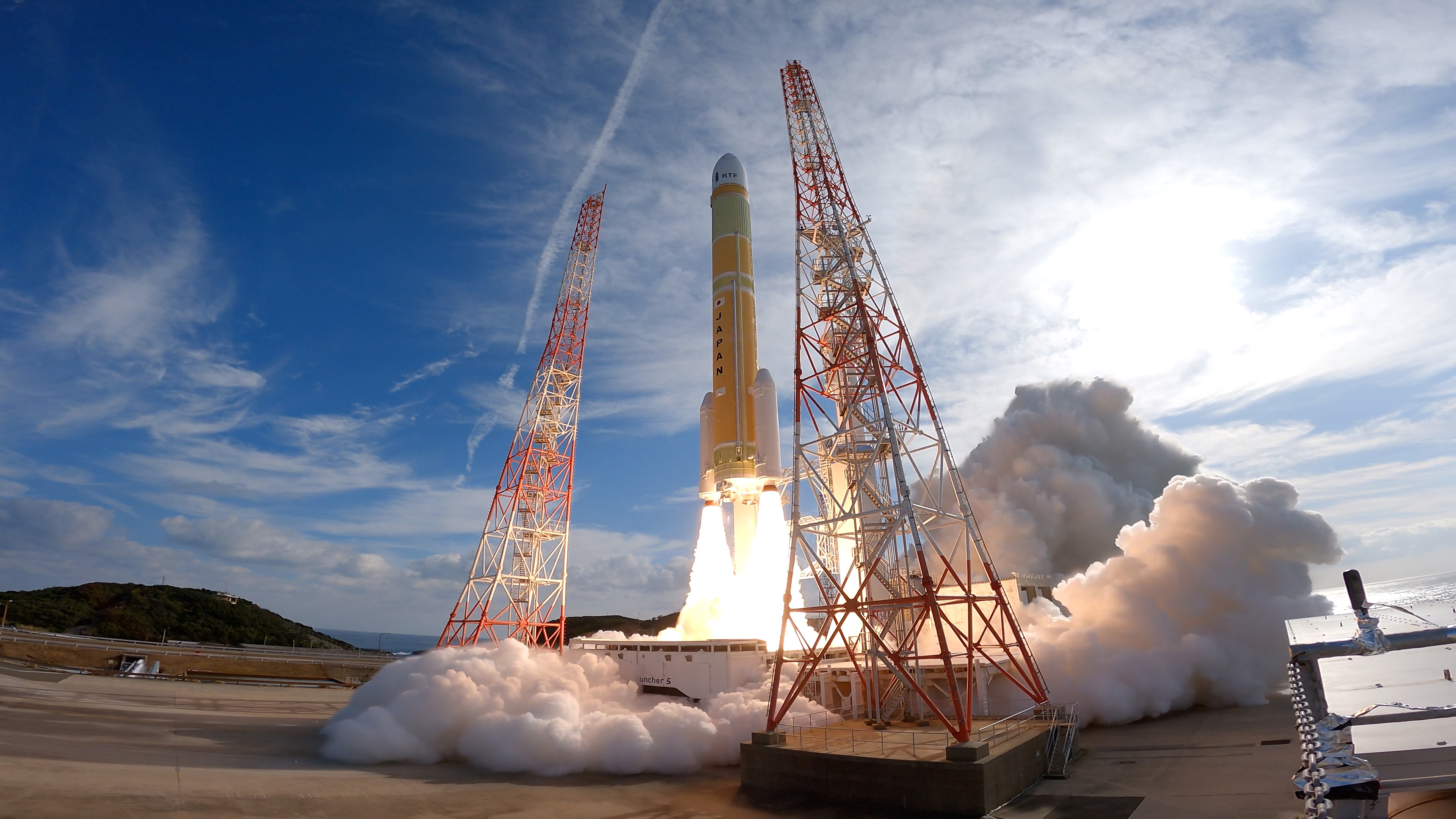
Mission image · JAXA

Mission overview
QZSS (Quasi Zenith Satellite System) is a Japanese satellite navigation system operating from inclined, elliptical geosynchronous orbits to achieve optimal high-elevation visibility in urban canyons and mountainous areas. The navigation system objective is to broadcast GPS-interoperable and augmentation signals as well as original Japanese (QZSS) signals from a three-spacecraft constellation. The navigation system objective is to broadcast GPS-interoperable and augmentation signals as well as original Japanese (QZSS) signals from a three-spacecraft constellation in inclined, elliptical geosynchronous orbits.
- Mission
- Michibiki 7 (QZS-7)
- Mission type
- Navigation
- Provider
- Mitsubishi Heavy Industries
- Target orbit
- Geostationary Transfer Orbit
Timeline
Scheduled event sequence from Launch Library 2. These are planned milestones, not confirmed telemetry. Events remain unconfirmed until a verified source reports them.
Liftoff
19:23 UTCFirst upwards movement of the rocket
SCHEDULED
SRB Separation
19:25 UTCThe solid rocket boosters are separated from the launcher.
SCHEDULED
Fairing Separation
19:27 UTCSeparation of the payload fairing
SCHEDULED
MECO
19:28 UTCCut-off of the main engine
SCHEDULED
Stage 2 Separation
19:28 UTCSeparation of the second stage from the first
SCHEDULED
SES-1
19:28 UTCFirst start of the second engine
SCHEDULED
SECO-1
19:36 UTCFirst cut-off of the second engine
SCHEDULED
SES-2
19:47 UTCSecond start of the second engine
SCHEDULED
SECO-2
19:52 UTCSecond cut-off of the second engine
SCHEDULED
Payload Separation
19:52 UTCFinal deployment of the payload from the rocket
SCHEDULED
Mission intelligence
Explore connectionsMission activity
Listening for verified changes
Activity appears when ORBITAL observes a change between source records. No historical events are invented.
Read source update
Spacecraft separation.
Liftoff.
Official Webcast by JAXA | 宇宙航空研究開発機構 has started
Refined launch window.
Delayed to NET August 10 UTC due to launch site weather.
Rescheduled for NET August 9 UTC.
Delayed due to launch site weather (effects of Typhoon Dolphin).
NET August 6 UTC.
Delayed to TBD due to previous H3 launch failure.
GO for launch.
NET 2025.
Schedule history
No changes recorded
Changes are recorded when ORBITAL retrieves data. The detection time may differ from the time the source changed its information.
Rocket
H3-22Mitsubishi Heavy Industries · JapanThe H3 Launch Vehicle is a Japanese expendable launch system. Each H3 booster configuration has a two-digit and a letter designation that indicates the features of that configuration. The first digit represents the number of LE-9 engines on the main stage, either "2" or "3". The second digit indicates the number of SRB-3 solid rocket boosters attached to the base of the rocket, and can be "0", "2" or "4". All layouts of solid boosters are symmetrical. The letter in the end shows the length of the payload fairing, either short "S" or long "L". For example, an H3-24L has two engines, four solid rocket boosters, and a long fairing, whereas an H3-30S has three engines, no solid rocket boosters, and a short fairing.
Payload
Michibiki 7 (QZS-7)
Payload details are described in the mission overview. No independently structured payload manifest or payload mass has been provided by the source.
Target orbit
SCHEMATIC · NOT A FLIGHT TRAJECTORY
- Orbit
- Geostationary Transfer Orbit
- Classification
- GTO
Launch site
Yoshinobu Launch Complex LP-2
Tanegashima Space Center, Japan
- Latitude
- 30.40094°
- Longitude
- 130.97564°
- Country
- Japan
- Time zone
- Asia/Tokyo
Live & mission coverage
Official mission broadcast. Stream availability is controlled by the provider.
Independent coverage (1)
Sources
Source links and confidence are preserved with each mission. Official updates take priority when verified.
Launch Library 2high · P80
ll.thespacedevs.com · Updated Sep 12, 2026 23:43 UTCOfficial mission updatehigh · P100
www.jaxa.jp · Updated Sep 12, 2026 23:43 UTCMission referencemedium · P60
www.youtube.com · Updated Sep 12, 2026 23:43 UTCOfficial mission updatehigh · P100
www.jaxa.jp · Updated Sep 12, 2026 23:43 UTCOfficial mission updatehigh · P100
www.jaxa.jp · Updated Sep 12, 2026 23:43 UTCOfficial mission updatehigh · P100
global.jaxa.jp · Updated Sep 12, 2026 23:43 UTCOfficial mission updatehigh · P100
www.jaxa.jp · Updated Sep 12, 2026 23:43 UTCOfficial mission updatehigh · P100
www.jaxa.jp · Updated Sep 12, 2026 23:43 UTCOfficial mission updatehigh · P100
global.jaxa.jp · Updated Sep 12, 2026 23:43 UTCMission photographs are provided by the original sources. Their rights remain with their creators; consult the source before reusing an image.