Launch success.
China Aerospace Science and Technology Corporation / MISSION BRIEFING
SpaceSail Polar Group #14
Long March 8A · Communications
Success
LAUNCH TIMEMISSION COMPLETETiming is subject to mission updates
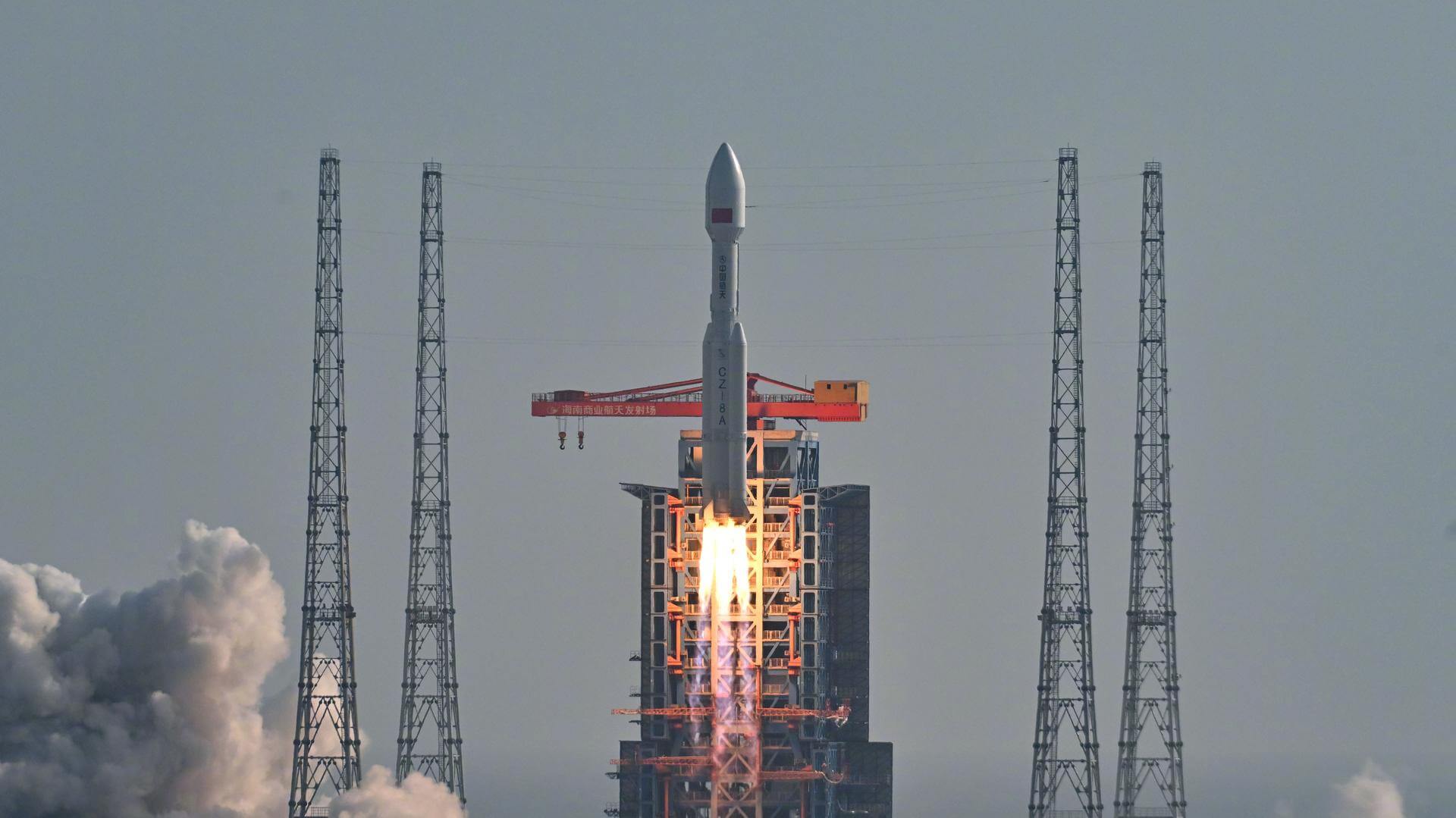
Mission image · CASC
Mission overview
20 Low Earth Orbit communication satellites with Ku, Q and V band payloads for the G60 constellation operated by Shanghai Spacesail Technologies with funding backed by the Shanghai local government. Initial constellation will consist of 1296 satellites by 2027 with long term plans to expand it to 12000 satellites.
- Mission
- SpaceSail Polar Group #14
- Mission type
- Communications
- Target orbit
- Polar Orbit
Timeline
Scheduled event sequence from Launch Library 2. These are planned milestones, not confirmed telemetry. Events remain unconfirmed until a verified source reports them.
A verified event timeline has not been published for this mission.
Mission intelligence
Explore connectionsMission activity
Listening for verified changes
Activity appears when ORBITAL observes a change between source records. No historical events are invented.
Read source update
Liftoff.
Confirmed planning for launch on July 5.
Delayed due to launch site weather (also updated possible payload based on https://forum.nasaspaceflight.com/index.php?topic=65317.msg2800982#msg2800982).
Refined launch window and updated launch vehicle identity per on-site sightings.
Added launch per NOTAMs; Payload and launch vehicle identities uncertain.
Schedule history
No changes recorded
Changes are recorded when ORBITAL retrieves data. The detection time may differ from the time the source changed its information.
Rocket
Long March 8AChina Aerospace Science and Technology Corporation · ChinaThe Long March 8A is an orbital launch vehicle developed by the China Academy of Launch Vehicle Technology based on the Long March 8. It has an increased capability of up to 7 tonnes to a 700 km altitude sun-synchronous orbit. It implements a larger 3.35 meters diameter liquid hydrogen/liquid oxygen 2nd stage, coupled with 2 upgraded version of the YF-75D engines used on the Long March 5 (known as the YF-75H) with increased thrust to 10 tonnes each through measures such as increased turbopump speeds. The Long March 8A can also use a larger 5.2 meters diameter payload fairing.
Payload
SpaceSail Polar Group #14
Payload details are described in the mission overview. No independently structured payload manifest or payload mass has been provided by the source.
Target orbit
SCHEMATIC · NOT A FLIGHT TRAJECTORY
- Orbit
- Polar Orbit
- Classification
- PO
Launch site
Commercial LC-1
Wenchang Space Launch Site, People's Republic of China
- Latitude
- 19.59727°
- Longitude
- 110.93075°
- Country
- China
- Time zone
- Asia/Shanghai
Live & mission coverage
No verified official livestream has been announced. Check mission sources for coverage updates.
Sources
Source links and confidence are preserved with each mission. Official updates take priority when verified.
Launch Library 2high · P80
ll.thespacedevs.com · Updated Jul 7, 2026 14:33 UTCMission referencemedium · P60
m.weibo.cn · Updated Jul 7, 2026 14:33 UTCMission referencemedium · P60
www.youtube.com · Updated Jul 7, 2026 14:33 UTCMission referencemedium · P60
forum.nasaspaceflight.com · Updated Jul 7, 2026 14:33 UTCMission referencemedium · P60
forum.nasaspaceflight.com · Updated Jul 7, 2026 14:33 UTCMission referencemedium · P60
forum.nasaspaceflight.com · Updated Jul 7, 2026 14:33 UTCMission referencemedium · P60
forum.nasaspaceflight.com · Updated Jul 7, 2026 14:33 UTCMission photographs are provided by the original sources. Their rights remain with their creators; consult the source before reusing an image.