Mission completed with Ship 41 soft splashdown in the Pacific Ocean.
SpaceX / MISSION BRIEFING
Starlink Group 31-1 (Starship Flight 14)
Starship V3 · Communications
Success
LAUNCH TIMEMISSION COMPLETETiming is subject to mission updates
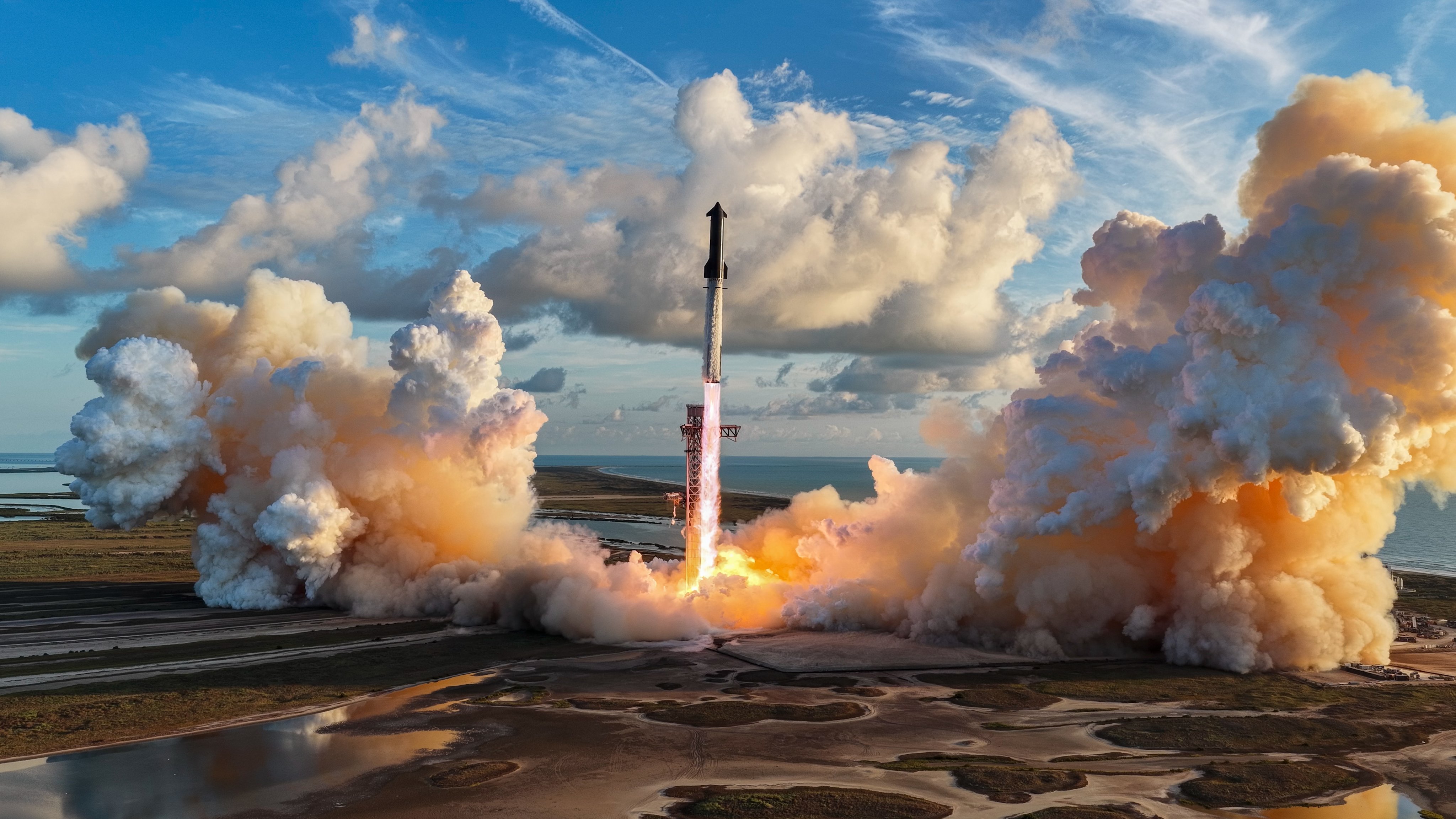
Mission image · SpaceX

Mission overview
14th test flight of the two-stage Starship launch vehicle. 3rd flight of Starship V3 and the first Starship flight to deploy satellites (a group of Starlink satellites known as Starlink Group 31-1) into stable Low Earth Orbit. The ship is expected to fly at an altitude approximately 275 km above Earth and complete approximately 6 orbits around the planet for nearly 10 hours, with splashdown targeted in the Pacific Ocean west of Chile. The booster’s primary test objective on Flight 14 will be executing a successful launch, ascent, stage separation, boostback burn, and landing burn at an offshore landing point in the Gulf. Starship will deliver 26 Starlink V3 satellites to orbit for the first time, which aim to greatly expand the network's capacity and user speeds. Each Starlink V3 satellite will add 1 Tbps of capacity to the constellation.
- Mission
- Starlink Group 31-1 (Starship Flight 14)
- Mission type
- Communications
- Provider
- SpaceX
- Target orbit
- Low Earth Orbit
Timeline
Scheduled event sequence from Launch Library 2. These are planned milestones, not confirmed telemetry. Events remain unconfirmed until a verified source reports them.
GO for Prop Load
11:58 UTCLaunch director verifies go for propellant load
SCHEDULED
Stage 1 LOX Load
12:12 UTCStart of liquid oxygen loading in the first stage
SCHEDULED
Stage 1 LNG Load
12:13 UTCStart of liquid methane loading in the first stage
SCHEDULED
Stage 2 LOX Load
12:14 UTCStart of liquid oxygen loading in the second stage
SCHEDULED
Stage 2 LNG Load
12:14 UTCStart of liquid methane loading in the second stage
SCHEDULED
Engine Chill
12:27 UTCStart of engine chilling
SCHEDULED
Stage 1 Propellant Load Complete
12:46 UTCEnd of propellant loading in the first stage
SCHEDULED
Stage 2 Propellant Load Complete
12:46 UTCEnd of propellant loading in the second stage
SCHEDULED
GO for Launch
12:48 UTCLaunch director verifies go for launch
SCHEDULED
Flame Deflector Activation
12:48 UTCActivation of the flame deflector ahead of engine ignition
SCHEDULED
Ignition
12:48 UTCStart of the engine ignition sequence
SCHEDULED
Liftoff
12:48 UTCFirst upwards movement of the rocket
SCHEDULED
Excitement Guaranteed
12:48 UTCExcitement guaranteed
SCHEDULED
Max-Q
12:49 UTCMaximum dynamic pressure
SCHEDULED
MECO
12:51 UTCCut-off of the main engine
SCHEDULED
Stage 2 Separation
12:51 UTCSeparation of the second stage from the first
SCHEDULED
Booster Boostback Burn Startup
12:51 UTCStart of the booster boostback burn
SCHEDULED
Booster Boostback Burn Shutdown
12:52 UTCEnd of the booster boostback burn
SCHEDULED
Stage 1 Landing Burn
12:55 UTCStart of the first stage landing burn
SCHEDULED
Stage 1 Landing
12:56 UTCLanding of the first stage
SCHEDULED
SECO-1
12:57 UTCFirst cut-off of the second engine
SCHEDULED
Orbital Insertion Burn Start
13:14 UTCThe spacecraft ignites it's engines to insert itself into orbit
SCHEDULED
Orbital Insertion Burn End
13:14 UTCThe spacecraft cuts its engines after inserting itself into orbit
SCHEDULED
Payload Deployment Sequence Start
13:23 UTCStart of the payload deployment sequence
SCHEDULED
Payload Deployment Sequence End
13:53 UTCEnd of the payload deployment sequence.
SCHEDULED
Deorbit Burn Start
21:41 UTCStart of the ship's deorbit burn
SCHEDULED
Deorbit Burn End
21:41 UTCEnd of the ship's deorbit burn
SCHEDULED
Atmospheric Entry
22:17 UTCStart of the atmospheric re-entry
SCHEDULED
Starship Transonic
22:36 UTCStarship passing through the transonic regime
SCHEDULED
Starship Subsonic
22:37 UTCStarship reaches a subsonic velocity
SCHEDULED
Starship Landing Burn
22:39 UTCStart of the Starship orbital stage landing burn
SCHEDULED
Landing Flip
22:39 UTCFlip maneuver to set the orientation for landing
SCHEDULED
Starship Landing Burn Shutdown
22:39 UTCShip landing burn engine(s) shutdown
SCHEDULED
Starship Landing Burn Shutdown
22:39 UTCShip landing burn engine(s) shutdown
SCHEDULED
Starship Landing
22:39 UTCLanding of the Starship orbital stage
SCHEDULED
Mission intelligence
Explore connectionsFlight hardware
Ship 41 · Low Earth Orbit
Mission activity
Listening for verified changes
Activity appears when ORBITAL observes a change between source records. No historical events are invented.
Read source update
All Starlink satellites deployed and in contact with ground stations.
Liftoff.
Unofficial Re-stream by SPACE AFFAIRS has started
Now targeting Sep 28 at 12:48 UTC
Now targeting Sep 28 at 12:46 UTC
FAA launch license acquired.
Now targeting Sep 28 at 13:15 UTC due to still pending regulatory approval
Renamed primary payload.
GO for launch.
NET September 22, TBC.
Added tentative launch window.
NET September 18.
NET September 15, TBC.
NET early September.
Added launch.
Schedule history
No changes recorded
Changes are recorded when ORBITAL retrieves data. The detection time may differ from the time the source changed its information.
Rocket
Starship V3SpaceX · United StatesThird development version of the Starship reusable two-stage super heavy-lift launch vehicle.
Payload
Starlink Group 31-1 (Starship Flight 14)
Payload details are described in the mission overview. No independently structured payload manifest or payload mass has been provided by the source.
Target orbit
SCHEMATIC · NOT A FLIGHT TRAJECTORY
- Orbit
- Low Earth Orbit
- Classification
- LEO
Launch site
Orbital Launch Pad 2
SpaceX Starbase, TX, USA
- Latitude
- 25.99677°
- Longitude
- -97.15799°
- Country
- United States
- Time zone
- America/Chicago
Live & mission coverage
Official mission broadcast. Stream availability is controlled by the provider.
Sources
Source links and confidence are preserved with each mission. Official updates take priority when verified.
Launch Library 2high · P80
ll.thespacedevs.com · Updated Sep 29, 2026 15:33 UTCOfficial mission updatehigh · P100
www.spacex.com · Updated Sep 29, 2026 15:33 UTCMission referencemedium · P60
x.com · Updated Sep 29, 2026 15:33 UTCMission referencemedium · P60
x.com · Updated Sep 29, 2026 15:33 UTCMission referencemedium · P60
www.youtube.com · Updated Sep 29, 2026 15:33 UTCMission referencemedium · P60
drs.faa.gov · Updated Sep 29, 2026 15:33 UTCMission referencemedium · P60
x.com · Updated Sep 29, 2026 15:33 UTCMission referencemedium · P60
www.fly.faa.gov · Updated Sep 29, 2026 15:33 UTCMission referencemedium · P60
compass.atfm.aero · Updated Sep 29, 2026 15:33 UTCMission photographs are provided by the original sources. Their rights remain with their creators; consult the source before reusing an image.