Launch success with telescope solar panels/sunshade deployed.
SpaceX / MISSION BRIEFING
Nancy Grace Roman Space Telescope
Falcon Heavy · Astrophysics
Success
LAUNCH TIMEMISSION COMPLETETiming is subject to mission updates
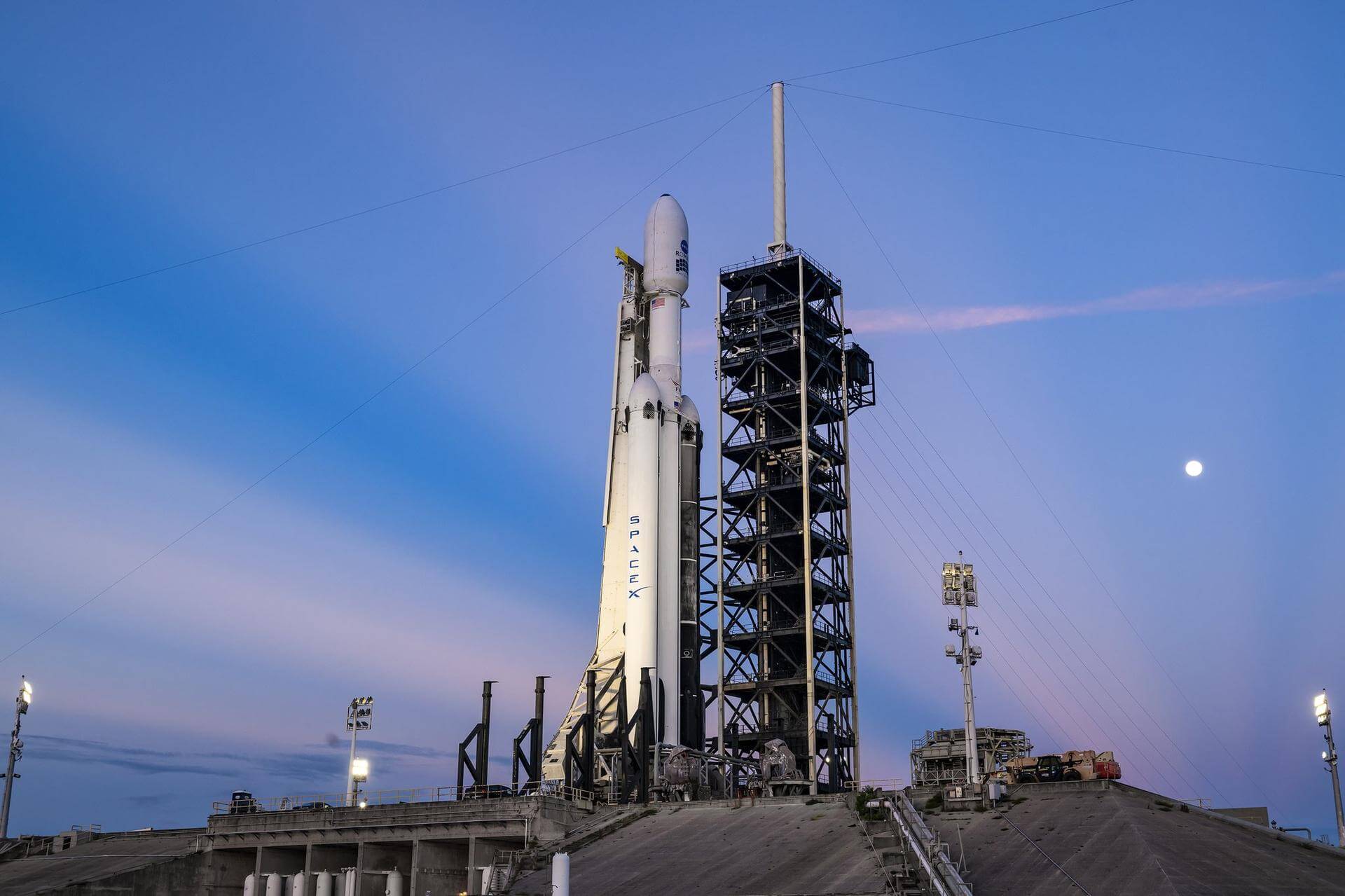
Mission image · SpaceX
Mission overview
The Nancy Grace Roman Space Telescope is a NASA infrared space telescope with a 2.4 m (7.9 ft) wide field of view primary mirror and two scientific instruments. The Wide-Field Instrument (WFI) is a 300.8-megapixel multi-band visible and near-infrared camera, providing a sharpness of images comparable to that achieved by the Hubble Space Telescope over a 0.28 square degree field of view, 100 times larger than imaging cameras on the Hubble. The Coronagraphic Instrument (CGI) is a high-contrast, small field of view camera and spectrometer covering visible and near-infrared wavelengths using novel starlight-suppression technology. Roman objectives include a search for extra-solar planets using gravitational microlensing, and probing the expansion history of the Universe and the growth of cosmic structure, with the goal of measuring the effects of dark energy, the consistency of general relativity, and the curvature of spacetime.
- Mission
- Nancy Grace Roman Space Telescope
- Mission type
- Astrophysics
- Provider
- SpaceX
- Target orbit
- Sun-Earth L2
Timeline
Scheduled event sequence from Launch Library 2. These are planned milestones, not confirmed telemetry. Events remain unconfirmed until a verified source reports them.
GO for Prop Load
10:33 UTCLaunch director verifies go for propellant load
SCHEDULED
Stage 1 Propellant Load
10:36 UTCStart of propellant loading in the first stage
SCHEDULED
Stage 1 LOX Load
10:41 UTCStart of liquid oxygen loading in the first stage
SCHEDULED
Stage 2 Propellant Load
10:51 UTCStart of propellant loading in the second stage
SCHEDULED
Stage 2 LOX Load
11:07 UTCStart of liquid oxygen loading in the second stage
SCHEDULED
Engine Chill
11:19 UTCStart of engine chilling
SCHEDULED
Startup
11:25 UTCThe onboard computer takes control over the countdown and runs last checks
SCHEDULED
GO for Launch
11:25 UTCLaunch director verifies go for launch
SCHEDULED
Tank Press
11:25 UTCFuel tanks are pressurized to flight levels
SCHEDULED
Ignition
11:25 UTCStart of the engine ignition sequence
SCHEDULED
Liftoff
11:26 UTCFirst upwards movement of the rocket
SCHEDULED
Max-Q
11:27 UTCMaximum dynamic pressure
SCHEDULED
SBECO
11:28 UTCCut-off of the side boosters
SCHEDULED
Boosters Separation
11:28 UTCSeparation of the side boosters
SCHEDULED
Boosters Flip
11:28 UTCFlip maneuver of the side boosters
SCHEDULED
Boosters Boostback Burn Startup
11:28 UTCStart of the boosters boostback burn
SCHEDULED
Boosters Boostback Burn Shutdown
11:29 UTCEnd of the boosters boostback burn
SCHEDULED
MECO
11:29 UTCCut-off of the main engine
SCHEDULED
Stage 2 Separation
11:29 UTCSeparation of the second stage from the first
SCHEDULED
SES-1
11:30 UTCFirst start of the second engine
SCHEDULED
Fairing Separation
11:30 UTCSeparation of the payload fairing
SCHEDULED
Boosters Entry Burn Startup
11:32 UTCStart of the boosters atmospheric entry burn
SCHEDULED
Boosters Entry Burn Shutdown
11:32 UTCEnd of the boosters atmospheric entry burn
SCHEDULED
Boosters Landing Burn
11:33 UTCStart of the boosters landing burn
SCHEDULED
Boosters Landing
11:33 UTCLanding of the boosters
SCHEDULED
SECO-1
11:34 UTCFirst cut-off of the second engine
SCHEDULED
SES-2
11:50 UTCSecond start of the second engine
SCHEDULED
SECO-2
11:52 UTCSecond cut-off of the second engine
SCHEDULED
Payload Separation
11:57 UTCFinal deployment of the payload from the rocket
SCHEDULED
Mission intelligence
Explore connectionsFlight hardware
Mission activity
Listening for verified changes
Activity appears when ORBITAL observes a change between source records. No historical events are invented.
Read source update
Payload deployed.
Liftoff!
Updated launch weather, 70% GO.
Official Webcast by NASA has started
Now targeting Aug 30 at 11:26 UTC
Updated launch weather, 50% GO (launch window per https://x.com/spaceflightnow/status/2093717878302216462).
Now targeting Aug 30 at 11:25 UTC
Updated launch weather, 60% GO.
GO for launch.
Tweaked T-0.
Setting GO.
Added tentative launch time.
NET August 30.
NET late August.
May move up to NET early September.
NET September 28.
NET September.
Adding launch NET October 2026
Schedule history
No changes recorded
Changes are recorded when ORBITAL retrieves data. The detection time may differ from the time the source changed its information.
Rocket
Falcon HeavySpaceX · United StatesThe Falcon Heavy is a variant of the Falcon 9 full thrust launch vehicle and consists of a standard Falcon 9 rocket core, with two additional boosters derived from the Falcon 9 first stage.
Payload
Nancy Grace Roman Space Telescope
The Nancy Grace Roman Space Telescope is a NASA infrared space telescope based on an existing 2.4 m (7.9 ft) wide field of view primary mirror and carrying two scientific instruments. The Wide-Field Instrument (WFI) is a 300.8-megapixel multi-band visible and near-infrared camera, providing a sharpness of images comparable to that achieved by the Hubble Space Telescope over a 0.28 square degree field of view, 100 times larger than imaging cameras on the Hubble. The Coronagraph Instrument (CGI) is a high-contrast, small field of view camera and spectrometer covering visible and near-infrared wavelengths using novel starlight-suppression technology.
Target orbit
SCHEMATIC · NOT A FLIGHT TRAJECTORY
- Orbit
- Sun-Earth L2
- Classification
- L2
Launch site
Launch Complex 39A
Kennedy Space Center, FL, USA
- Latitude
- 28.60823°
- Longitude
- -80.60428°
- Country
- United States
- Time zone
- America/New_York
Live & mission coverage
Official mission broadcast. Stream availability is controlled by the provider.
Sources
Source links and confidence are preserved with each mission. Official updates take priority when verified.
Launch Library 2high · P80
ll.thespacedevs.com · Updated Sep 13, 2026 03:03 UTCOfficial mission updatehigh · P100
www.spacex.com · Updated Sep 13, 2026 03:03 UTCOfficial mission updatehigh · P100
www.nasa.gov · Updated Sep 13, 2026 03:03 UTCMission referencemedium · P60
x.com · Updated Sep 13, 2026 03:03 UTCMission referencemedium · P60
x.com · Updated Sep 13, 2026 03:03 UTCMission referencemedium · P60
www.youtube.com · Updated Sep 13, 2026 03:03 UTCMission referencemedium · P60
45thweathersquadron.nebula.spaceforce.mil · Updated Sep 13, 2026 03:03 UTCMission referencemedium · P60
45thweathersquadron.nebula.spaceforce.mil · Updated Sep 13, 2026 03:03 UTCOfficial mission updatehigh · P100
science.nasa.gov · Updated Sep 13, 2026 03:03 UTCMission photographs are provided by the original sources. Their rights remain with their creators; consult the source before reusing an image.